CBP Seizure at Otay Mesa What Happens After Your Truck Is Seized and How to Get It Back

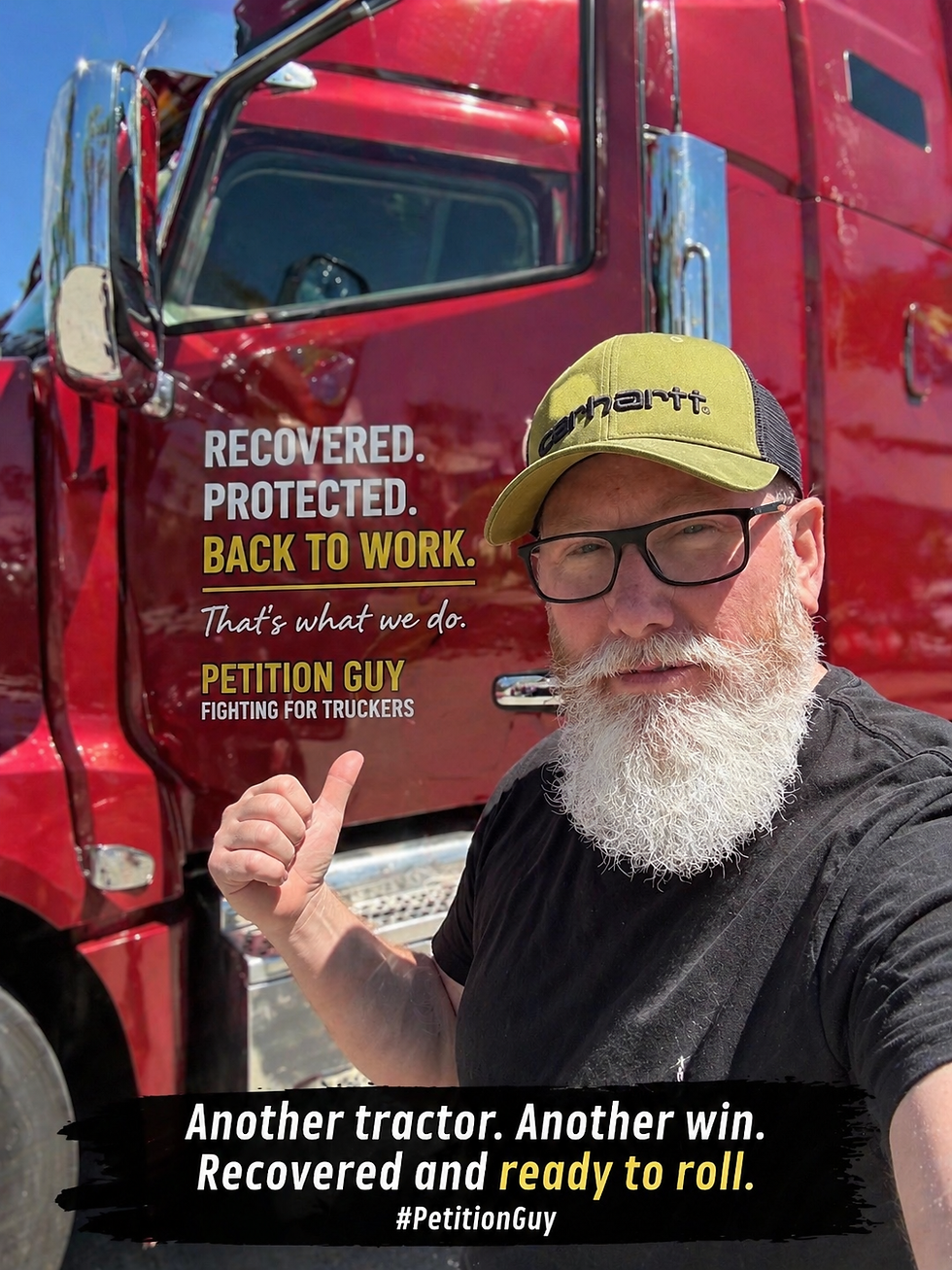
When U.S. Customs and Border Protection (CBP) seizes your truck, trailer, car, vessel, or cargo, everything stops.
Your business.
Your income.
Your momentum.
And if you don't act quickly - you could lose everything permanently.
This isn't theory. This is happening right now.
Actual Case Example
On November 9, 2025, CBP seized
A 2017 Kenworth tractor (valued at $25,000)
A 2011 refrigerated trailer (valued at $3,000)
The seizure was tied to allegations of "Facilitating importation contrary to law" and "zero tolerance controlled substance violations". Multiple parties were notified from the owners, operators, importers, manufactures and various business entities because CBP assumes anyone connected may have an interest in the property and vehicles.
What CBP Doesn't Tell You Clearly
Most people think... “It’s my truck. I wasn’t driving it. I had no idea anything illegal was happening—so once I explain that, they’ll give it back.”
That's not how this works.
Criminal forfeiture - In summary, against a person after conviction.
Civil judicial forfeiture - In summary, against the property in court.
Administrative forfeiture - In summary, handled by the agency without court involvement.
Here's the part most people don't realize. Your CBP case almost always starts as administrative forfeiture.
When CBP seizes your truck, car, vessel or any commerical vehicle, the case typicallyas an in rem action. It means the action is against the property itself—not you as a person.
That means:
The truck is treated as the “defendant”
No criminal charge is required
CBP only needs probable cause to seize
If you don’t respond properly, the property is forfeited without going to court
That’s exactly why your notice doesn’t give you a court date. Instead, it gives you “election of proceedings” options—because the burden is now on you to act.
Your 4 Options
Why Most People Choose Wrong
Option >>> Petition for Remission and/or Mitigation
This is where you tell your story and request the return of your property. Under federal law (19 U.S.C. §1618), CBP can return property if there was no willful negligence, there was no intent to violate the law and there are mitigating circumstances.
This is where experience matters. A weak petition gets denied or maxium mitigated penalty is assessed. A strong one gets results.
Option >>> Offer in Compromise
This is where you essentially offer a sum of money to settle the case. It is not an admission of guilt. You write your petition making the offer of compromise including the funds. Note, federal law requires the acceptance of electronic transfers (ACH, wire transfers), checks, credit cards and cash. However, I have encountered CBP's FP&F Offices only accepting money orders or cashier check.
Option >>> Abandon the Property
This is simple. You walk away. CBP keeps everything.
People feel overwhelmed and don't want to deal with the seizure. The whole process is stressful and it is compounded when you are principled person and respect the law.
Others lack the financial ability. I know of a vehicle seizure where the owner was waiting in the vehicle crossing traffic and a passer-by placed a marjiuana cigarette (a joint) on the vehicle. He had no idea it was present nor that his vehicle was being used to import a controlled substance. CBP K9 detected the marjiuana cigarette. Because of the zero tolerance enforcement actions of CBP, the vehicle was seized. The vehicle was worth almost nothing and was used to by the owner (a senior citizen) to get to his low paying job in the United States. He abandoned the vehicle.
Abandon is an option when you have no legal interest in the truck, car, or vessel.
Option >>> Judicial Action (Federal Court)
You force the government to prove its case.
If your vehicle is seized for violating Title 8 - Aliens and Nationality you fall under Civil Assist Forfeiture reform Act of 2000 (CAFRA). You are not required to post a bond but you have to pay close attention to deadlines outlined in your seizure notice. Pay close attention to the date of the seizure and the deadlines stated.
If your vehicle is seized for violating Title 19 - Customs Duties you will fall under the "Customs Carve Out" process known as "Non-CAFRA". The "Customs Carve Out" refers to a specific exception in the Civil Assist Forfeiture reform Act of 2000 (CAFRA) that allows CBP to use faster, administrative procedures for seizing property rather than stricter, court based civil forfeiture rules.
To contest a non-CAFRA seizure judicial, you must file a claim and cost bond of $5,000 or 10% of the value, whichever is lower, but not less than $250.00.
Hidden Strategy Most People Miss
The goal is not just to respond. The goal is to establish innocent owner defense, show lack of knowledge or intent, docment business legitmacy and control the narrative before CBP makes a decision.
Because once CBP decides you're fighting an uphill battle.
Need Help With CBP Seizure?
At Petition Guy we specialize in CBP seizure response strategies, petition drafting, case positioning for the best possible outcome.
If your truck, trailer, vehicle, vessel or cargo has been seized don;t guess. Don't delay. Get it handled right.


Comments